
Cannabis Social Clubs & Asociaciones Cannábicas in Spain (2026 Tourist Guide)
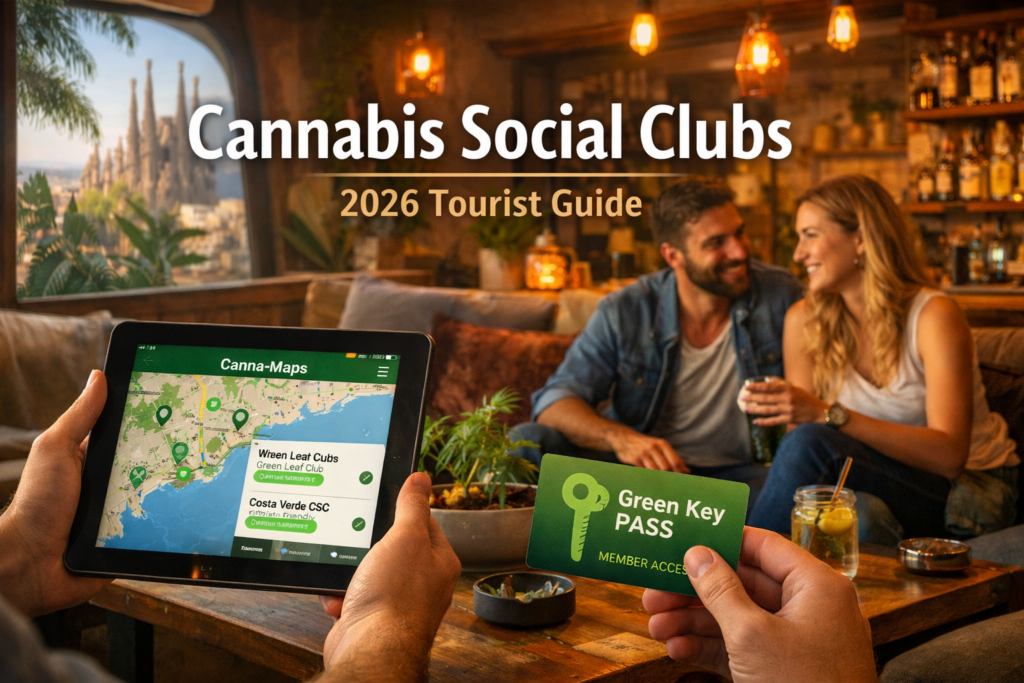
Last updated 13 August 2026.
Spain doesn’t have cannabis dispensaries. Instead, access runs through private, non-profit associations — Asociaciones Cannábicas, better known as Cannabis Social Clubs — and understanding that distinction is the first thing to get right before you go looking for one.
Is Cannabis Legal in Spain in 2026?
Not for public sale. Private cultivation and consumption within a private space are decriminalised under constitutional rights to privacy and association, but public possession and public consumption remain administrative offences, punishable by fines under Spain’s Citizen Security Law (Ley Orgánica 4/2015). You can read the official legislation here.
That legal framework is exactly what allows Asociaciones Cannábicas to operate as private member associations rather than retail businesses — the model works because nothing is sold and nothing is public. As of mid-2026, nothing enacted nationally changes this framework, though club regulation keeps evolving at the regional and city level — see the Barcelona note below.
What Is an Asociación Cannábica?
A private, non-profit organisation where registered adult members collectively cultivate cannabis for their own consumption. In practice that means:
- Members-only access — no walk-ins
- No public advertising or storefronts
- Non-profit association structure, not a business
- Consumption stays private, inside the club
Whether you’re looking for a club in Barcelona, Tenerife, or Madrid, the structure is broadly the same nationwide.
Barcelona: Tighter Local Rules Since 2024
Barcelona remains the country’s benchmark city for cannabis social clubs, but it’s also where regulation has moved fastest. Between 2024 and 2026, the city council introduced a new ordinance reinforcing public-health criteria, limiting where clubs can be located, and tightening operational requirements for associations. If Barcelona is your destination, expect more compliance-conscious clubs than a few years ago — membership and ID checks are stricter, not looser.
Can Tourists Join a Cannabis Social Club in Spain?
Yes — but entry is never automatic. Most clubs ask for:
- Valid passport or EU ID
- Minimum age (18–21+, depending on the club)
- Pre-registration and approval
- A referral from an existing member
- Agreement to the club’s own internal rules
That referral requirement is the main thing that trips up visitors unfamiliar with how the Spanish association model works — see our full membership rules guide for exactly how it plays out in practice.
How Joining Actually Works
The process is more structured than it used to be:
- Submit a membership request
- Provide identification
- Complete association registration
- Pay the annual membership contribution
- Wait for approval before visiting
Turning up without approval usually just gets you turned away at the door.
Mistakes Tourists Actually Make
- Buying from street dealers — illegal, and genuinely unsafe
- Consuming on beaches or in public parks
- Assuming clubs work like dispensaries
- Not pre-registering before travelling
- Ignoring a club’s own privacy rules once inside
Respecting the private-association model matters everywhere from mainland Spain to the Canary Islands — it’s the whole reason this system is tolerated at all.
Finding a Verified Club
Because these clubs operate privately, they don’t show up on ordinary map apps. Canna-Maps keeps verified, current listings across:
- Tenerife
- Gran Canaria
- Lanzarote
- Fuerteventura
- Barcelona
- Alicante & the Costa Blanca
- Málaga & the Costa del Sol
- Madrid, Ibiza and other mainland regions
A verified directory cuts out a lot of the guesswork, and helps you find clubs that actually take international members.
Skipping the Referral Wait
Since most clubs need a sponsoring member, the Green-Key Cannabis Club Membership Pass exists to shortcut that — it pre-confirms access with partner clubs before you travel, so a slow or rejected application doesn’t cost you a day of a short trip.
FAQ
Is cannabis legal in the Canary Islands?
Same legal framework as mainland Spain. Public consumption is prohibited everywhere.
What’s the difference between a dispensary and an Asociación Cannábica?
Dispensaries are retail businesses. Spanish Cannabis Social Clubs are private, non-profit associations — nothing is sold, only shared among members.
Can I take cannabis out of Spain?
No. Transporting cannabis across international borders is illegal, regardless of how you obtained it.
Are Cannabis Social Clubs legal in 2026?
They operate within Spain’s private-association framework and existing case law, but regulation continues to evolve region by region — Barcelona’s 2024–2026 ordinance is the clearest recent example — and there’s still no single national cannabis-club law.
Explore verified clubs and membership options. This guide is for informational purposes only — always follow local laws and consume responsibly.